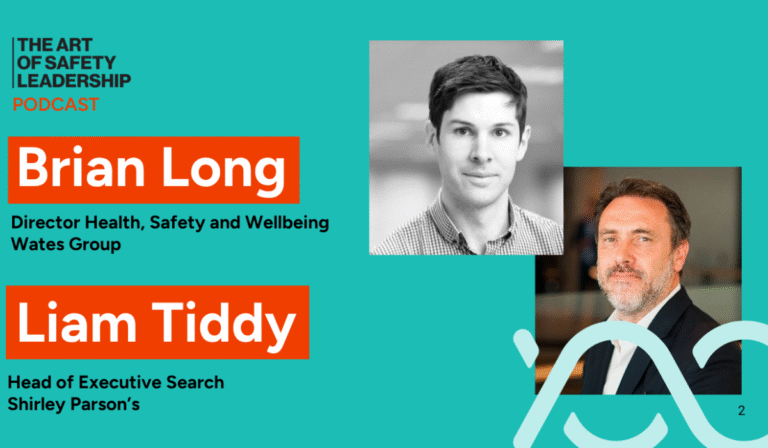

How can organisations build safety functions that create strategic value rather than simply ensure compliance?
That’s the question explored in the latest episode of Safe365’s Art of Safety Leadership podcast, featuring Liam Tiddy, Head of Executive Search at Shirley Parsons, and Brian Long, Group Health & Safety Director at Wates Group.
From compliance to strategic value.
Reflecting on almost two decades in the industry, Liam notes how expectations of health and safety professionals have transformed:
“In 2005, compliance was the be-all and end-all for most companies. That’s definitely shifted. Today, there’s much more expectation around business sense – how health and safety can help the organisation be successful. It’s no longer a bolt-on; it’s part of the core strategy.”
Brian echoes that sentiment, adding that the safety leaders who stand out are those who can make safety feel like a value-add: “The ones that succeed are those who can make safety feel like a value contributor to the overall success of the company. They keep people safe and actively drive performance and trust.”
Finding balance in a complex landscape.
While organisations aim to move beyond compliance, regulatory demands continue to grow.
“People say compliance is just the baseline, but the reality is the bar keeps rising. The challenge is building performance and innovation on top of that foundation.”
Compliance, both agree, should be seen as a platform for resilience and long-term value, not the finish line.
Evolving the leadership mindset.
The future of safety leadership hinges on adaptability and curiosity.
“Traditionally, safety leaders have been quite fixed in their thinking – anchored to principle or moral stance. But today’s business world is full of trade-offs between profitability, sustainability, and safety. The modern leader needs adaptability, curiosity, and commercial understanding.”
Safety leaders are increasingly strategic enablers, providing insight and coaching so executives can make informed decisions.
Developing future leaders.
Aspiring safety leaders must actively seek growth beyond their comfort zones. Liam says:
“For developing leaders, it’s about taking on challenges that stretch you — joining executive committees, engaging with regulators, building networks, and staying visible on the shop floor. The best leaders are both strategic and hands-on. Candidates who’ve worked across sectors or held commercial roles are highly valued. The best health and safety directors would be great leaders in any discipline, the safety part is just one dimension.”
Broadening skills and development pathways.
Leadership doesn’t have to follow a linear path. Operations experience, general management roles, or postgraduate business education can all enhance leadership capability.
“Exposure to communication, finance, and commercial disciplines builds a broader appreciation for what makes a business succeed. That diversity of experience invariably makes you a better leader.”
Designing the modern safety team.
Liam emphasises diversity of skill and thought in building the teams of the future:
“In the past, safety teams were often made up of ‘mini-mes’. Today’s risks are far more complex. We need people with backgrounds in analytics, sustainability, HR — those who can interpret data and communicate insights.”
Brian adds that understanding the organisation’s unique safety landscape is essential:
“At Wates, our work spans high-hazard operations to wellbeing and mental health. Understanding your risk landscape is essential to shaping the right team and capability.”
Shaping the future of safety leadership.
At Shirley Parsons, we help organisations build the next generation of safety leaders — professionals who combine technical excellence with curiosity, business acumen, and empathy.
Liam’s insights reflect our mission: to elevate the profession and demonstrate how effective safety leadership drives lasting business value.
“The best health and safety directors aren’t just compliance experts — they’re strategic leaders who make safety a source of resilience and performance.”